
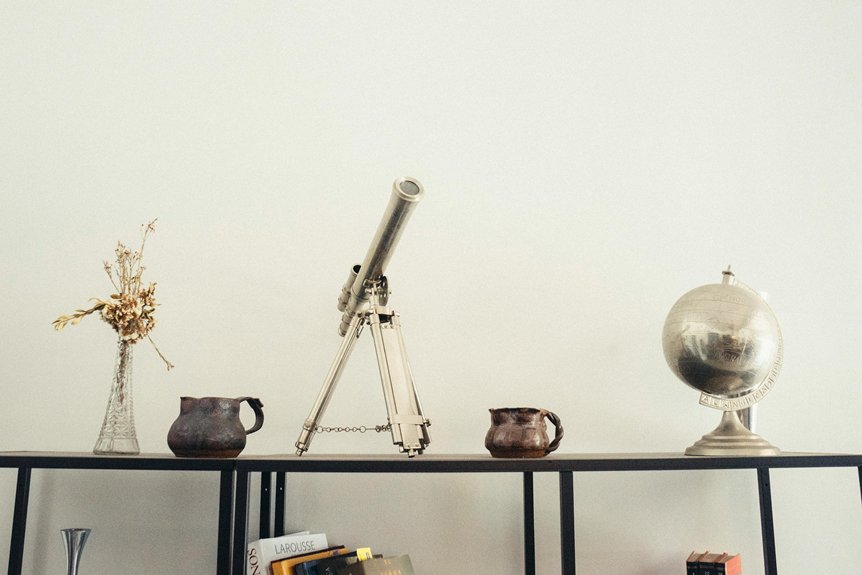
When choosing the best telescope for beginners in 2025, focus on optical quality, telescope aperture and focal length guide, and ease of use. Refractor models offer sharp images with low maintenance, while reflectors provide larger apertures at best beginner telescope under $300-friendly prices but need occasional alignment. Look for stable mounts and portability for convenience. Consider Seestar S50 smart telescope review options to help locate best telescope for seeing planets quickly. Balancing these features with your budget guarantees a satisfying start to stargazing. Further details reveal how to optimize your initial experience effectively.
Top Features to Look for in Beginner Telescopes
When choosing a beginner telescope, you’ll want to focus on features that balance ease of use with quality performance.
Prioritize optical quality and aperture size, as these determine how much light the telescope gathers and the clarity of your views.
Consider magnification power, but remember it depends on aperture for true detail.
Look for a user friendly design with mount stability to guarantee steady observations.
Portability features allow you to explore freely, while budget considerations help you find value.
Additional accessories can enhance your experience but shouldn’t complicate setup or operation.
This balance guarantees freedom without sacrificing function.
Review of the Best Beginner Telescopes in 2025
Choosing the right beginner telescope involves carefully weighing the features discussed earlier, such as aperture size, optical quality, and ease of use.
In 2025, several models stand out for offering affordable options without compromising performance. Compact designs are prevalent, making setups easier to transport and store.
For instance, refractor telescopes provide sharp images and low maintenance, ideal for newcomers. Reflectors offer larger apertures at budget-friendly prices but require occasional alignment.
Some computerized models assist with locating celestial objects, enhancing your exploration freedom. By focusing on these practical choices, you can select a beginner telescope that fits your needs and encourages consistent stargazing.
Tips for Getting Started With Your New Telescope
Although owning a new telescope can be exciting, you’ll want to start by familiarizing yourself with its components and functions before heading outdoors.
Begin your telescope setup by carefully reading the manual and assembling parts step-by-step. Practice adjusting the focus and aligning the finderscope indoors.
Once comfortable, choose a clear night with minimal light pollution to observe the night sky. Start with bright objects like the Moon or planets to get a feel for tracking.
Keep a star chart or app handy to identify constellations. Proper preparation guarantees a smooth experience while exploring the freedom of the night sky.
Frequently Asked Questions
How Do Weather Conditions Affect Telescope Viewing Quality?
You can’t see much through heavy cloud cover, and atmospheric turbulence blurs your view, making stars twinkle more. Choose clear, calm nights to enjoy sharper, freer telescope viewing without interference from the weather’s chaos.
Can Beginner Telescopes Be Used for Astrophotography?
Yes, you can use beginner equipment for astrophotography. With basic astrophotography techniques, you’ll capture stunning images while enjoying the freedom to explore the night sky without complicated gear or steep learning curves.
What Maintenance Is Required for a Beginner Telescope?
You’ll need to handle basic telescope cleaning carefully and always use lens protection to avoid scratches. Keep it dust-free, store it safely, and you’ll enjoy your freedom exploring the stars without worrying about damage or grime.
Are There Any Safety Precautions When Using a Telescope?
You should never look directly at the sun through your telescope, even during setup. Follow user guidelines carefully to avoid eye damage, and make sure your telescope setup is stable to keep your viewing experience safe and enjoyable.
How Do I Transport My Telescope Without Damaging It?
You’ll want to use sturdy telescope cases to protect your gear. When transporting, secure all parts, avoid jostling, and carry it upright. These transport tips keep your telescope safe, so you can freely explore the stars.
About the Author